
Families comparing private vs. public high school for college admissions want clear guidance, not assumptions. Many parents worry about whether public or private schools give students an advantage in the competitive college admissions process, especially when applying to Ivy League, Top 50, or other selective colleges.
But admissions officers read every application in context, meaning the decision is never simply about which type of school is “better.” It is about which school environment gives an individual student the resources, rigor, and support they need to thrive.
This guide explains how college admissions officers evaluate public and private high school backgrounds, how rigor and grades work differently across environments, and how students can make the right choice based on their strengths, academic interests, and goals.
Students often need guidance when choosing between their local public high school and a private high school, transferring to a new school, or wondering whether public schools tend to offer fewer advanced courses. This comparison will help you make an informed decision for your child’s education and long-term college acceptance outcomes.
How Admissions Interprets School Profile, Rigor, and Environment
With every college application, admissions officers begin by reviewing the school profile, a document submitted by the high school that explains course offerings, access to AP or IB classes and honors courses, average class size, demographic information, grading policies, and specialized programs. This breakdown is how colleges understand the level of academic rigor available to students.
A private school education often showcases smaller classes, more personalized instruction, and more resources in core subjects, electives, and specialized programs. Public schools, especially those with large student populations, may offer extensive AP or IB course listings, wide academic programs, and a more diverse environment. Highly competitive schools demonstrate that exceptional rigor exists in both settings.
Admissions officers never compare private schools to public schools broadly. They compare the individual student against the opportunities available at their specific school. If a student attends a school with limited resources but takes the most rigorous courses available, admissions teams recognize that achievement. And if a student attends a top private school filled with highly motivated students, the expectation for rigor is naturally higher because many private schools offer advanced coursework starting in middle school.

Rigor and Grades Depend on Each Environment
Families often assume that private schools automatically give students an advantage because of stronger academic support and more rigorous courses. In reality, the balance between rigor and grades depends heavily on the individual school.
Private high schools may offer more rigorous courses, but grading can be competitive, and some schools even have grade deflation. These tougher policies can make it challenging for students to maintain top GPAs, which matter in the college admissions process. Still, admissions officers understand the difficulty of these academic programs because school profiles show the distribution of grades.
At many public high schools, students may have access to more AP classes, dual-enrollment options, or statewide honors courses. The challenge often comes from navigating large classes or limited teacher availability. Yet students who excel in these environments show strong independence and resilience, qualities valued by highly selective colleges.
The core question is whether a student is choosing course rigor that matches their academic interests and demonstrates their strongest potential. For some students, a structured private school education with more personalized instruction helps them reach higher levels of achievement. For others, the breadth of opportunities in public schools provides room to explore and define their paths.
Courses, Extracurricular Activities, Counseling, and Letters of Recommendation
Choosing between public and private schools means comparing the opportunities that will influence a student’s strength in college applications.
Academic Programs:
Many private schools emphasize advanced humanities, languages, or STEM tracks and may offer specialized programs that support high-achieving students interested in Ivy League colleges. Strong public education systems may offer similarly rigorous programs, but resource levels vary widely across districts.
Extracurricular Activities:
Both school types offer clubs, sports, and community service opportunities. However, some private schools fund niche activities such as robotics labs, debate programs, or performing arts conservatories. Large public high schools may provide broad extracurricular activities with competitive teams, expansive arts programs, or well-known academic competitions.
College Counseling:
Families often view counseling as a significant difference. Private school students sometimes benefit from more individualized attention from school counselors, more comprehensive college counseling, and deeper guidance on the college application process. In contrast, public school students often share counselors with hundreds of students, though many counselors in public schools are highly experienced professionals.
Letters of Recommendation:
Smaller class sizes in private schools allow faculty to write rich, personalized recommendations. At public high schools, teachers with heavier course loads may have less time, though strong relationships and impactful recommendations remain very possible for motivated students.
What matters most is whether the student has access to meaningful relationships, strong mentorship, opportunities for leadership, and room to grow in alignment with their academic interests and long-term goals.
A Five-Point Checklist for Families Making Impactful Decisions
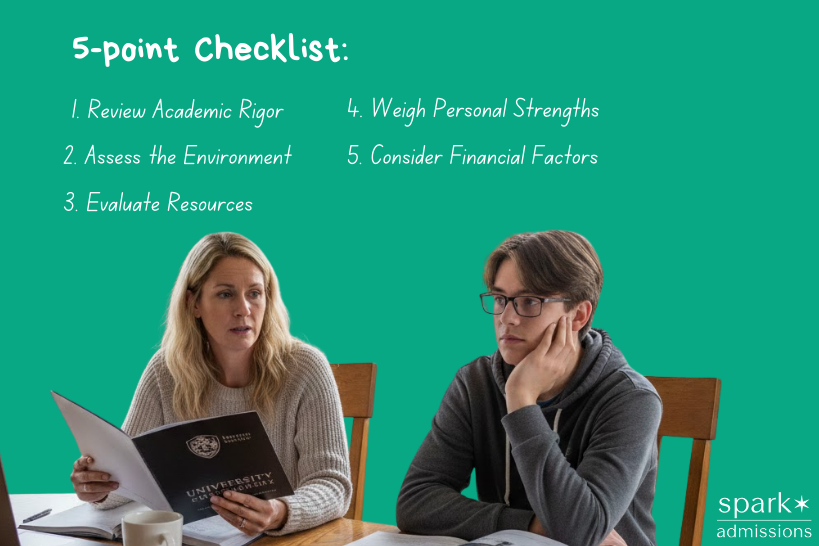
Families comparing environments often struggle because there is no single correct answer for all students. Use this checklist to evaluate which school supports your student’s ability to thrive academically and personally.
First, review academic rigor.
Does the school offer rigorous courses that match your student’s ability and goals? Can they take more rigorous courses over time in a way that shows academic progress?
Second, assess the environment.
Consider class sizes, individualized attention, and whether your student benefits more from structure or independence.
Third, evaluate resources.
Look at advanced classes, specialized programs, standardized testing preparation, clubs, leadership roles, and support systems.
Fourth, weigh personal strengths.
Does the environment motivate your student? Will they be surrounded by peers who support their academic interests and student success?
Fifth, consider financial factors.
Families should evaluate private school tuition, transportation, financial aid availability, and their long-term educational plans, including grad school or specialized academic pathways.
Frequently Asked Questions
Do colleges prefer private schools?
No. Selective colleges do not prefer private schools over public high schools. They evaluate students in the context of their school’s opportunities, rigor, and environment.
Does school rigor matter more than GPA?
Both matter. Admissions officers look for students who challenge themselves appropriately and earn strong grades within the context available at their school.
What if my school has grade deflation?
Admissions teams are aware of grading patterns through the school profile, so grade deflation will not penalize students unfairly.
Does access to IB or AP courses matter?
Access to IB or AP courses affects how colleges read rigor, but students are never penalized for lacking programs that their school does not offer.
Can students switch schools for strategic advantages?
Switching can help if the new school provides resources that match the student’s needs, but the right choice depends on each student’s ability to adapt to a new environment.
Supporting Families in Choosing the Right School
Choosing between public schools and private schools is ultimately a decision about the environment that will best support your student’s academic programs, motivation, and long-term success. Our counselors help families evaluate rigor, opportunities, and personal strengths, using tools and data to understand how different school types influence outcomes at selective colleges, Ivy League schools, and other top universities.
Spark Admissions provides expert guidance on every step of preparing for and applying to college, but we do not stop there. We view the college preparation period as a time for skill-set development. In addition to offering application guidance, we help students navigate the academic demands of high school, heighten their leadership and communication skills, and explore new academics and extracurriculars to build the strongest possible application.
Walk through your options with a Spark counselor to make the most informed decision for your student’s future.