
Every year, many high school students consider participating in volunteer abroad high school trips, often in tropical locations, with the goal of gaining experience, exploring a new culture, and boosting their college applications. This kind of travel, often called “voluntourism,” blends vacation with volunteer work, but it’s increasingly recognized as a surface-level form of social impact that rarely results in sustainable development or a lasting positive impact on host communities.
For students applying to competitive colleges, especially Early Decision, Early Action, and Top 50 schools, understanding the difference between voluntourism programs and meaningful service is essential. Selective admissions officers now look beyond good intentions and seek genuine commitment, long-term involvement, and service that prioritizes the local community and its needs.

What Is “Voluntourism” and Why Has It Become So Prevalent?
The rise of volunteer tourism has roots in increased international travel, globalization, and a desire among young people in Western countries to “make a difference.” Many high schoolers want to explore different cultures, develop personal growth, and contribute to solutions for environmental issues, healthcare inefficiencies, or economic inequality in other countries.
The idea sounds appealing: fly to Thailand, Cambodia, or Haiti for a week or two, engage in short-term volunteer work, and return home with photos that look impactful on social media. On the surface, it appears to benefit both students and communities. However, the benefits of voluntourism have been widely questioned by nonprofits, development experts, and now college admissions committees.
Over the past decade, a growing number of researchers, journalists, and global organizations have examined the paradox of voluntourism. While volunteers arrive with good intentions, their presence can unintentionally create dependence, displace local workers, or undermine local professionals who could perform the same work more efficiently and sustainably. Colleges have taken note, and the message is clear: admissions officers no longer view a short-term service trip abroad as impressive or meaningful.
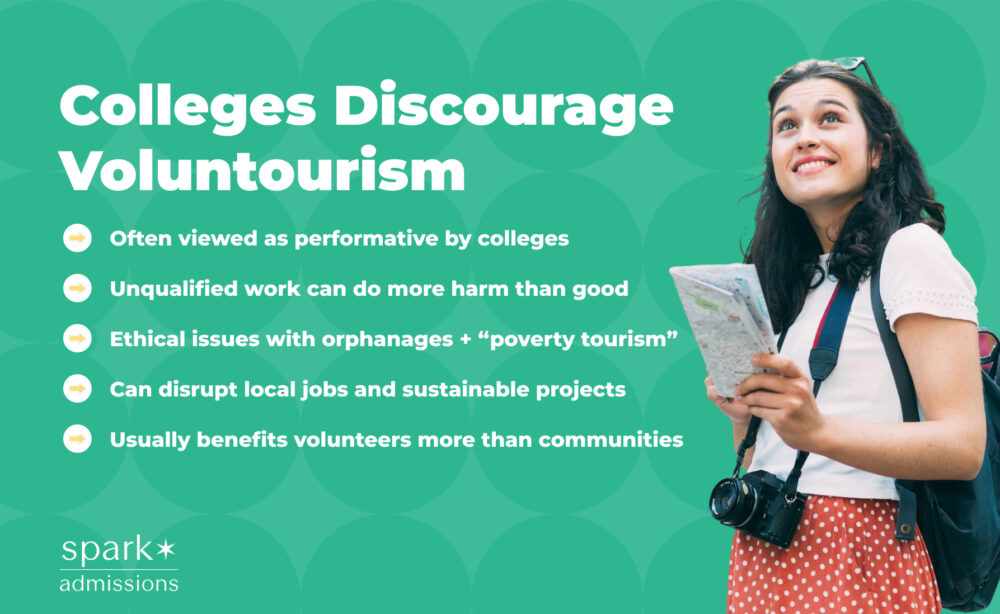
Why Colleges Discourage Voluntourism
From an admissions standpoint, weeklong trips to build a school, paint a community center, or volunteer at orphanages are seen as more self-serving than altruistic. Particularly at Top 50 colleges, application readers are trained to spot “performative service,” activities done for the resume rather than for the local community.
Selective colleges increasingly discourage the kind of travel in which unqualified volunteers take on work better suited to trained local professionals, such as medical care or healthcare support. Likewise, orphanage tourism has come under significant scrutiny. Short-term trips to care for vulnerable children can contribute to attachment disorders, emotional instability, and, in some countries, even a market that incentivizes separating children from families for tourism profit.
Admissions committees also recognize the pattern of students from the United States engaging in service projects in the Global South. Students traveling to economically disadvantaged areas may be overlooking meaningful needs at home or opportunities to contribute to the local community and support local businesses.
Simply put, the ethics and effectiveness of voluntourism are at odds with what highly selective colleges value: depth, humility, long-term commitment, and impact rooted in real understanding and collaboration with community members.
The Hidden Consequences for Host Communities
First, voluntourism can disrupt local workers and the local economy. When groups of students arrive to build infrastructure or deliver basic services for free, they can unintentionally eliminate paid jobs for skilled laborers. This approach reduces employment opportunities and delays sustainable solutions.
Second, short-term volunteer projects frequently fail to support sustainable development. Even when projects are well-intentioned, short stays, insufficient student training, and poor coordination with host communities mean the work rarely continues once volunteers leave. Without buy-in from community leaders, projects often remain unfinished or unused.
Third, an influx of volunteers cycles through communities without forming meaningful relationships. Students often leave feeling fulfilled, while the community remains unchanged. This repeated pattern has fueled critiques that voluntourism is more beneficial to the traveler than to the community.
The final concern involves ethics. In countries that need the most help, demand for voluntourism has fueled troubling industries, from faux orphanages to staged “poverty experiences,” markets built around travelers’ desire to “help.” These developments reveal that voluntourism is not a neutral activity; it can cause real harm.

How to Make a Real Impact, Not Photo Ops
Given the consequences of voluntourism, what do college admissions officers want to see instead? The answer is not to avoid travel or cross-cultural experiences altogether, but to pursue them responsibly and with humility.
Admissions readers prioritize authenticity, long-term involvement, and service that centers the needs of the community, not the optics for the student. They value students who take initiative, learn from community members, seek mentorship, and build partnerships rooted in respect rather than charity.
At Spark Admissions, we encourage students to focus on service that supports systemic change, collaboration, and sustainability. They should aim to pursue opportunities that address long-term solutions, involve community organizations, and empower local leaders instead of replacing them.
There are far more effective ways for students to contribute to global or domestic issues than short-term service trips. Below are some meaningful pathways that encourage the same exploration of a new culture and personal development without the pitfalls described above. Check out these alternatives to voluntourism:
Partnering with Established Nonprofits for Long-Term Support
Instead of booking a weeklong voluntourism trip through travel programs, students can form long-term partnerships with nonprofits working in areas such as education, healthcare, or environmental issues. Remote work, research support, fundraising, and awareness campaigns can significantly amplify impact.
Collaborating with community-led nonprofits allows students to contribute resources without disrupting existing systems.
Pursuing Local Impact with Global Relevance
Many of the issues students want to address abroad, including educational inequity, food insecurity, access to medical care, and climate change, also exist close to home. Students can gain impressive leadership experience by creating sustainable programs in their own communities. The local approach is often more challenging, more nuanced, and far more impressive to admissions officers.
Engaging in Cultural Exchange, Not Volunteer Tourism
Travel can still be a meaningful form of learning. Students can take part in language immersion, homestays, accredited academic programs, or cultural exchange initiatives that prioritize learning over service. These programs allow students to understand a new culture deeply without the ethical concerns of voluntourism.
Building Skills That Create Long-Term Social Impact
Admissions officers value students who use their talents to innovate. For example, a student passionate about sustainability might launch a climate awareness campaign; a student interested in public health might work with local clinics on community education efforts. The key is to create solutions that can continue after the student leaves.
Participate in Service That Matters
Spark Admissions helps students move beyond surface-level volunteer experiences and toward authentic, purpose-driven involvement that demonstrates maturity, leadership, and real impact. We guide students in identifying their passions, understanding global and local needs, and developing service initiatives rooted in respect and collaboration.
It is never too late to start preparing for the college admissions process. Moreover, we view the college preparation period as a time for skill-set development. In addition to offering application guidance, we help students navigate the academic demands of high school, gain practical experience through internships, heighten their leadership and communication skills, and explore new academics and extracurriculars to build the strongest possible application.
If you want to avoid the detriments of voluntourism and instead create a service experience rooted in real impact, sustainability, and ethical engagement, Spark Admissions is here to help. Book a consultation with us now to get started.