
- Blog
- > College Admissions
College Admissions for High-Achieving Students with Dyscalculia, Dysgraphia, and Auditory Processing Disorder
- Dr. Rachel Rubin
- | March 25, 2026

As awareness of learning differences continues to grow, more families and educators recognize that academic excellence and learning disabilities can coexist. Many high-achieving high school students demonstrate strong intellectual ability, leadership, and curiosity while also managing specific learning differences such as dyscalculia, dysgraphia, and auditory processing disorder (APD).
Students with these learning profiles often complete challenging coursework, pursue ambitious academic goals, and contribute meaningfully to their communities. At the same time, the college admissions process can raise unique questions about documentation, accommodations, and whether—or how—to share information about a learning difference.
With thoughtful planning and the right support, students with learning disabilities can thrive in higher education, access strong academic programs, and develop the independence and self-advocacy that support long-term success.
Understanding Dyscalculia, Dysgraphia, and Auditory Processing Disorder
Learning differences such as dyscalculia, dysgraphia, and auditory processing disorder affect how students process certain types of information, not their overall intelligence or potential.
Dyscalculia primarily impacts mathematical reasoning and number processing. A student may excel in reading, writing, or conceptual thinking while needing extra support with calculations or quantitative reasoning.
Dysgraphia can affect written expression, including handwriting, spelling, and the organization of written ideas. Students with dysgraphia may have strong verbal insight but find it difficult to translate those ideas onto the page.
Auditory processing disorder influences how students interpret spoken information. Students with APD may need additional time to process lectures or may benefit from written instructions or recorded materials.
Many students receive support during K–12 education through Individualized Education Programs (IEPs) or 504 plans, which provide accommodations and services within public schools under the Individuals with Disabilities Education Act (IDEA).
When students transition to college, however, the legal framework changes. Postsecondary institutions operate under civil rights laws such as the Americans with Disabilities Act and Section 504 of the Rehabilitation Act. These laws protect access to accommodations but require students to request support and provide documentation themselves.
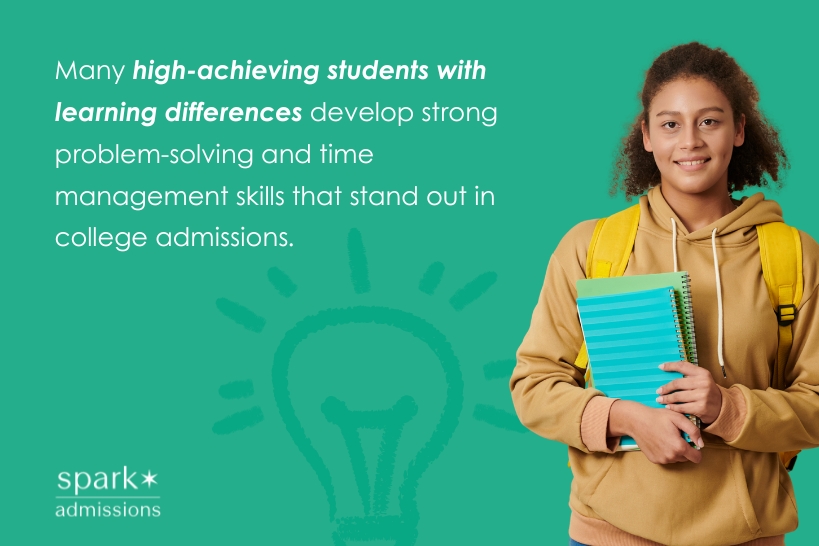
High Achievement and Learning Differences
A common misconception in college admissions is that learning disabilities automatically indicate weaker academic preparation. In reality, many students with learning differences maintain strong grades, pursue rigorous coursework, and demonstrate remarkable resilience.
High-achieving students with learning differences often build advanced skills in organization, time management, and problem-solving as they learn strategies to navigate academic challenges. These strengths frequently translate into leadership roles, research experiences, community engagement, or creative pursuits.
College admissions committees increasingly take a holistic approach when reviewing applications. Intellectual curiosity, perseverance, and personal growth are often considered alongside grades, course rigor, standardized tests, and extracurricular involvement.
When students choose to share their learning experiences thoughtfully—often through personal essays or the Additional Information section of the Common App—it can provide context that highlights persistence, self-advocacy, and personal development.
Navigating the College Admissions Process
The college admissions process itself follows the same fundamental structure for students with learning differences as for other applicants. Students submit transcripts, standardized test scores if required, extracurricular activities, recommendations, and essays.
However, students with dyscalculia, dysgraphia, or auditory processing disorder may also consider additional factors when building their college lists. One key consideration is the availability and structure of disability services.
Most colleges and universities maintain disability services offices that coordinate accommodations and support for students with documented disabilities. These offices review documentation, determine eligibility for accommodations, and help students access resources such as note-taking support, tutoring services, alternative testing arrangements, or assistive technology tools.
Some students may wonder whether disclosing a learning difference will affect admission decisions. In practice, admissions officers generally focus on whether an applicant demonstrates readiness for academic work and engagement with their interests.
When students do choose to describe their learning experiences in their applications, the goal is to provide context rather than seek sympathy. Thoughtful reflection can highlight the strategies a student has developed and the ways they have grown through their academic experiences.
Transitioning from High School to College
The shift from high school to college represents an important transition for all students, and it can be particularly meaningful for students with learning differences.
In high school, educators and parents often play a central role in coordinating support services. Schools are responsible for identifying eligible students and providing accommodations.
In college, the process becomes more student-driven. Students must contact disability services offices themselves, submit documentation, and request accommodations as needed.
Developing self-advocacy skills becomes essential. Students who learn to communicate their needs, organize their schedules, and seek support when necessary are often well positioned to succeed academically and socially in college.
According to the National Center for Education Statistics, roughly one in five college students reports having some form of disability, with learning disabilities among the most common. As a result, many campuses have developed robust systems to support students and foster inclusive learning environments.
Academic Accommodations in College
Once admitted, students with documented learning differences may be eligible for a range of academic accommodations through campus disability services offices.
Common accommodations include extended time for exams, reduced-distraction testing environments, note-taking support, and access to assistive technology. Students with dysgraphia may benefit from speech-to-text tools or typing accommodations, while students with auditory processing disorder may receive lecture recordings or written lecture notes.
Many universities also offer workshops focused on time management, study strategies, and organizational skills. These resources can help students adapt to the increased independence of college learning.
Some institutions also offer specialized programs designed specifically for students with learning differences. These programs may include additional coaching, academic advising, and structured support designed to promote independence.
Financial Aid and Support Resources
Families sometimes ask whether students with documented learning disabilities have access to additional financial resources. In some cases, students may be eligible for scholarships, grants, or other forms of assistance connected to their learning profile.
Federal laws such as the Americans with Disabilities Act and the Rehabilitation Act require institutions that receive federal funding to provide equal access to educational opportunities. This includes accessible facilities, academic accommodations, and equitable treatment in admissions and financial aid policies.
Students may also explore scholarships offered by nonprofit organizations and foundations that support students with learning differences.
For some students, community colleges can provide a flexible starting point before transferring to a four-year institution. These pathways can help students build confidence, develop academic strategies, and transition to a bachelor’s degree program over time.

Building Skills for Long-Term College Success
Success in higher education depends on more than grades alone. It also involves independence, communication skills, and the ability to manage time and responsibilities effectively.
For students with learning differences, these qualities often develop through intentional skill-building during high school. Activities that strengthen self-advocacy, communication skills, and time management help prepare students for the transition to college.
Students may research colleges with strong disability services offices, explore standardized testing accommodations through the College Board, and evaluate academic programs that align with their strengths and interests.
How Spark Admissions Supports Students with Learning Differences
At Spark Admissions, our team includes former admissions officers, educators, special education professionals, and school leaders who bring extensive experience supporting students with diverse learning profiles. Our work focuses on three priorities: helping students make the most of their high school experience, positioning them for admission at colleges that recognize their strengths, and identifying environments where they will be well supported and able to thrive academically.
For students with learning differences, this may include helping families think through whether and how to provide context in an application, identifying colleges with strong academic and disability support resources, and strengthening the overall narrative of a student’s achievements. We also help students develop the skills and experiences that selective universities value, including leadership, internships, and intellectual exploration. If your family is beginning the college admissions process and has questions about learning differences, our team is happy to help you think through the options and develop a plan that supports your student’s goals.
Fill out our form to learn more.
About The Author