

Updated for the 2026-27 transfer cycle
Key Takeaways
- The transfer process follows a six-step sequence that typically spans six to nine months from initial research through enrollment.
- College GPA is the primary academic factor in transfer admissions and outweighs your high school record, particularly once you have accumulated 30 or more credit hours.
- Credits are evaluated individually at each institution and are not guaranteed to count toward your intended major.
- Financial aid does not transfer automatically. You must reapply for federal, state, and institutional aid at your new school.
- Many fall transfer deadlines fall between February and March, though some public systems close much earlier. Spring deadlines, where offered, often fall between July and November; some close as early as August or September.
Transferring colleges is one of the most consequential decisions an undergraduate can make, and also one of the most common. According to the National Student Clearinghouse Research Center’s Transfer Enrollment and Pathways report (March 2025), the number of students transferring to a new institution grew 4.4% in fall 2024, and transfer students made up 13.1% of all continuing and returning undergraduates. Whether you are moving from a community college to a four-year university, switching between four-year programs, or returning after a gap, the process demands careful planning and deliberate execution.
This guide walks through every stage of the transfer process in 2026: what it is, who qualifies, what colleges evaluate, and how to complete your applications strategically. Bookmark it as your working reference from research through enrollment.
What Is the College Transfer Process?
The college transfer process is the structured sequence a student follows to move from one institution to another with the goal of earning a bachelor’s degree or completing a credential program. Unlike applying to college for the first time, transfer applications center on your college record rather than your high school performance. Colleges evaluate your academic progress, your fit with the target institution’s programs, and your ability to articulate why the transfer serves your educational goals. Understanding this distinction from the outset is critical: the transfer process rewards students who have demonstrated college-level success, not just ambition.
What Is a Transfer Student?
A transfer student is any undergraduate who enrolls at a new institution after having previously attended another college or university. This category covers several distinct pathways. The most common is the two-year to four-year transfer, in which a community college student completes an associate degree or a defined set of prerequisites before moving to a university. The four-year to four-year transfer involves a student moving between universities, typically due to a change in academic direction, dissatisfaction with the current institution, or a better program match. Returning students who stopped attending their college for personal or financial reasons and international students transferring from institutions abroad also fall within this category, though each group faces its own set of admission requirements.
Common Reasons to Transfer Colleges
Students transfer for a range of academic, financial, and personal reasons. The most credible transfer cases are those driven by a clear, forward-looking rationale rather than a desire to escape a difficult situation.
- Academic mismatch: The current institution does not offer a major, research opportunity, or faculty concentration aligned with the student’s goals.
- Financial necessity: A more affordable option, a scholarship, or proximity to home makes another institution significantly more viable.
- Career repositioning: A student who has clarified professional goals finds that a different institution has stronger industry connections or program rankings in their field.
- Personal circumstances: Family obligations, health considerations, or a need to relocate make continuing at the current school impractical.

Should You Transfer Colleges?
The decision to transfer should be evaluated the same way you would evaluate any significant academic investment: with data, not just emotion. Strong reasons to transfer include genuine program limitations at your current school, a clearly defined opportunity at another institution, and a solid academic record that makes you a competitive applicant. Weak reasons (e.g., dissatisfaction with social life, a difficult semester, or a vague sense that another school would feel better) rarely produce successful transfers and often result in lost credits, delayed graduation, and additional cost.
Apply a go/no-go framework before committing to the process. If you can answer yes to all three of the following questions, transferring is likely the right call: Does the target school offer something your current school demonstrably cannot? Have you performed well enough academically to be competitive? And can you make the financial math work, including aid, housing, and time to graduation? If you are uncertain on any of these, invest another semester at your current institution and reassess.
“The most compelling transfer cases demonstrate clear academic purpose. Admissions committees look for evidence of progress at your current institution alongside a credible plan for contributing at the next one.” Dr. Rachel Rubin, Founder and CEO, Spark Admissions
How Hard Is It to Transfer Colleges in 2026?
The difficulty of transferring varies enormously by institution and program. For most transfer applicants, college grades carry the most weight, and the high school record matters less as you complete more college credit. How much less depends on the school: USC, for example, bases decisions largely on the high school record for applicants with fewer than 30 transferable semester units. Once you have a substantial college record, your college performance usually matters far more than the grades you earned in high school.
At highly selective institutions, transfer admission is exceptionally competitive. Columbia’s most recent public Common Data Set for Columbia College and Columbia Engineering (2025-26) reported 4,909 transfer applicants and 453 admits for fall 2025, about a 9% admit rate, and Stanford admitted 102 of 4,532 transfer applicants for fall 2025, about 2%. Most flagship state universities and mid-tier four-year colleges offer considerably higher transfer acceptance rates, particularly for students who have followed an articulation pathway from a community college. (It is worth noting, however, that there can be serious variance in transfer acceptance rates from one year to the next, depending on the college’s yield rate and other factors, so all of the aforementioned acceptance rates are less consistent than the ones for freshman admissions.)
The practical difficulty also depends on timing. Students who plan the process six to nine months in advance, identify target schools early, and build a strong college transcript and resume dramatically improve their odds relative to those who approach the process reactively.
College Transfer Requirements
Transfer requirements are institution-specific, but a core set of factors appears consistently across selective and moderately selective schools. Understanding these requirements before you begin shaping your list will allow you to assess your competitiveness honestly and allocate your application effort where it will have the most impact.
- GPA: Most four-year institutions require a minimum college GPA between 2.0 and 3.0, but competitive programs often expect a 3.0 or higher. Highly selective schools regularly admit transfer students with GPAs above 3.5. Your GPA at your current institution is the single most influential data point in your application.
- Credits completed: Credit requirements vary widely. Some colleges set a floor, such as 24 credits at Columbia College and Columbia Engineering, while others, like USC and Stanford, set no minimum. The University of California expects at least 60 semester units for junior-level transfer. Students with fewer credits may also need to submit high school transcripts and standardized test scores.
- Standardized tests: Test requirements for transfer applicants vary. Some institutions waive SAT/ACT requirements for transfer students who have completed 30 or more college credits; others require scores regardless. Check each school’s current policy before assuming you are exempt, and see our list of test-optional colleges for first-year policies that may also apply to newer transfer applicants.
- High school transcript: Required if you have fewer than 30 college credits. At that stage, high school performance still factors into the evaluation alongside your college record. (Many colleges will still want to see your grades from high school; they just won’t weigh them as heavily as your undergraduate performance to date.)
Documents You Need to Transfer
A complete transfer application involves several document types, each serving a distinct verification function. Missing a single required item can delay your application review or result in an incomplete file. Assemble these materials well before your target deadlines.
| Required Document | Purpose and Scope |
|---|---|
| Application Platform | Common App for Transfer, Coalition Application, state system, institutional portal |
| College Transcripts | Official records from every postsecondary institution attended |
| High School Transcript | Usually required, particularly when submitting with fewer than 30 college credits |
| College Report | Disciplinary and academic standing verification from your current school |
| Mid-Term Report | In-progress grade reports from your current semester professors |
| Recommendations | Academic letters from college instructors, not high school teachers |
| Transfer Essays | Core transfer essay plus any institution-specific supplement prompts |
| Program Materials | Course descriptions, syllabi, or portfolio for major-specific review |
How to Transfer Colleges in 6 Steps
The transfer process is manageable when it is broken into discrete, sequenced steps. The six stages below follow a logical order that keeps you on deadline and ensures each piece of your application is prepared with adequate time for review and revision. Most students should begin this sequence six to nine months before their target application date.
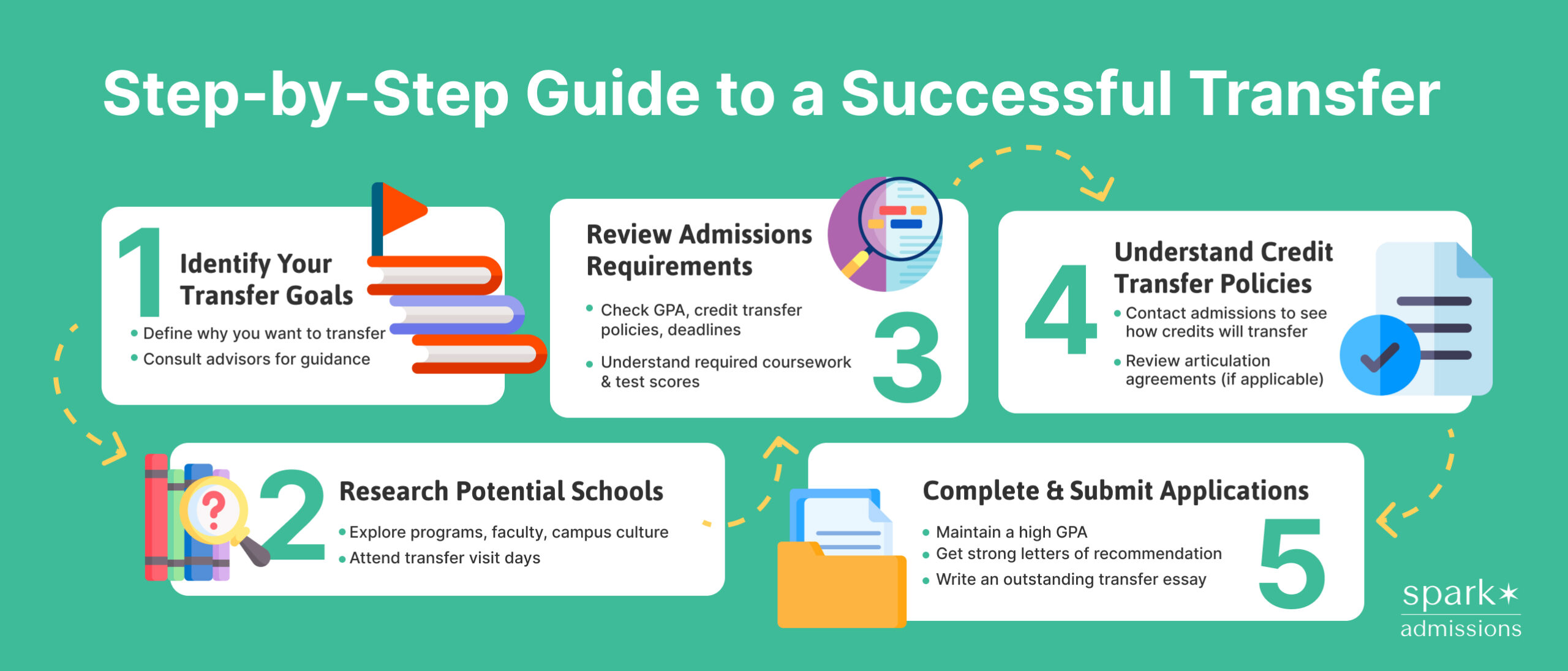 \n\nThis graphic is a five-stage overview of the process. The six steps below add a separate final step for financial aid and transfer scholarships.
Step 1: Define Your Transfer Goals
Before you research schools or request transcripts, clarify exactly what you expect transferring to accomplish. Vague goals produce weak applications. Specific goals (completing a degree in environmental policy at a school with a ranked program in that field, or reducing tuition costs by moving to an in-state public university) produce focused, persuasive ones.
Write out your rationale in a short paragraph. What does your current institution lack? What does the target institution offer that you cannot access elsewhere? How will transferring accelerate your academic or professional trajectory? This exercise is not merely preparatory; it is the foundation of your transfer essay and every conversation you will have with admissions officers.
Set concrete targets: your minimum and preferred GPA threshold, the number of credits you want to carry forward, and your non-negotiable program requirements. Students who define these parameters early make better school list decisions and spend their application energy more efficiently.
Step 2: Research and Choose Transfer Schools
Build a tiered school list of eight to twelve institutions that match your academic profile and program needs. Use a reach/match/likely framework: apply to two or three aspirational programs, four to six competitive matches, and two or three safer options where your credentials are clearly above the median transfer admit.
When evaluating programs, look beyond rankings. Examine transfer-specific acceptance rates, credit articulation policies, on-campus housing availability for transfer students, and financial aid packages for incoming transfers. Some schools have formal transfer pathways with guaranteed admission for students who meet defined GPA and credit requirements. Research the best colleges for transfer students and look for institutions with dedicated transfer orientation programs and transfer student support offices. These are meaningful signals of institutional commitment to this population.
Request informational meetings with transfer advisors at your target schools and attend virtual transfer information sessions where available. These conversations surface details, like department-specific GPA thresholds or impacted major enrollment caps, that do not appear in public-facing admission materials.
Step 3: Check Requirements and Deadlines
Transfer deadlines are non-negotiable. Missing one by even a day typically means waiting another full cycle. Many fall transfer deadlines fall between February and March, such as Columbia on March 1 and Cornell on March 15, but University of California campuses accept fall applications only from October 1 to November 30 of the year before. Spring deadlines, where offered, often fall between July and November, and many selective colleges admit transfers for fall only. Mark every school’s deadline in your calendar and work backward to establish submission and document request timelines.
For each school, confirm: the minimum GPA requirement for your intended major, the credit hours needed to qualify as a transfer applicant, whether standardized test scores are required, and which application platform the institution uses (Common App, Coalition App, or a proprietary portal). Review the transfer deadlines for your full list and schedule transcript requests, recommendation letter asks, and essay writing accordingly.
If you are unsure whether you have enough time in the current cycle, research when is it too late to transfer. Some schools offer rolling admission or have later deadlines than their flagship programs suggest.
Step 4: Confirm How Your Credits Will Transfer
Credit transfer is never automatic. Each institution evaluates incoming credits individually, comparing your completed courses against its own catalog equivalencies. A course that counts toward your major at your current school may transfer as a free elective, or not at all, at a new institution.
Understand how credits transfer before you finalize your school list. Contact the registrar or transfer credit office at each target institution and request a preliminary credit evaluation. Ask specifically: which of your completed courses will count toward your intended major’s requirements, which will count as general electives, and which will not transfer at all. For community college students, articulation agreements may define these equivalencies in advance. Our guide to credit transfer evaluation explains how registrars review each course.
A preliminary credit evaluation lets you calculate your projected time to graduation and compare true costs across your list. A school with a lower tuition rate may become more expensive in total if it accepts fewer of your credits and requires additional semesters to complete your degree.
Step 5: Complete and Submit Your Applications
More than 700 colleges accept the Common App for transfer. Common App plans to retire the separate transfer platform after the 2026-27 season, so check each school’s instructions for the year you apply. The Common App transfer application collects your academic history, activity record, transfer essay, and institutional reports in a single platform, streamlining submission to multiple schools.
Your transfer essay is the highest-leverage element of the application and the one most students underestimate. Admissions readers have your transcript and can see your grades; what they cannot see is your thinking, your purpose, and your readiness. Write a transfer essay that explains the specific academic or professional opportunity the target institution provides, demonstrates your research into the program, and shows what you have accomplished at your current school that prepares you to contribute. Study strong transfer essay examples for a sense of the structure and specificity that distinguish competitive writing from generic submissions.
Request College Reports and recommendation letters from instructors and advisors who know your college-level work. High school teachers are rarely appropriate recommenders for transfer applicants who have completed a full semester or more of college coursework. Give recommenders at least four to six weeks’ lead time to prepare their letters, and offer to provide them with a resume and any other materials that might be helpful to them.
Step 6: Apply for Financial Aid and Transfer Scholarships
Financial aid does not follow you from one institution to another. You file one FAFSA per academic year and add your new school to it by entering its federal school code; the online form holds up to 20 schools at a time. You must also apply for institutional aid directly at your target school. Filing as early as possible gives you access to the largest pool of federal, state, and institutional funding, and the FAFSA for the 2027-28 school year is already open.
Explore transfer scholarships and financial aid opportunities at each school, including merit-based awards for transfer students, departmental scholarships, and state-specific programs that support community college transfers. Some institutions offer dedicated transfer scholarships that are separate from general merit aid and have earlier deadlines. Request a net price calculation from each school’s financial aid office to compare realistic cost of attendance, not just sticker price.
What Happens After You Are Admitted as a Transfer Student
Receiving an admission offer is the beginning of your transition, not the end of your process. After admission, you will receive an official credit evaluation that details which of your completed credits will count at your new institution and toward which requirements. Review this carefully and appeal any decisions that appear inconsistent with the preliminary assessment you received.
Submit your enrollment deposit by the stated deadline to secure your spot. Notify your current institution of your withdrawal plans and confirm the date your enrollment will officially end. Many schools require formal withdrawal paperwork to release your official transcript.
Plan for housing early. Transfer students are frequently ineligible for on-campus housing or placed on waitlists after first-year students are accommodated. Research off-campus options in parallel with your enrollment decision rather than after. Register for transfer orientation as soon as enrollment opens. These sessions cover academic advising, registration, and campus services that directly affect your first-semester success.
Transferring From Community College to a Four-Year University
The community college to four-year pathway, often called the 2+2 model, is one of the most common transfer routes in American higher education. Community college students make up 38% of all U.S. undergraduates, according to the American Association of Community Colleges’ Fast Facts 2026.
The 2+2 model works best when students follow a formal articulation agreement: a documented credit-transfer compact between a community college and a four-year institution. Many state university systems maintain these agreements with in-state community colleges, guaranteeing that specific courses will satisfy equivalent requirements at the university. Completing an Associate of Arts or Associate of Science degree under an articulation agreement frequently provides a clearer path to junior standing than transferring without one.
For community college transfer students, the college GPA carries even greater weight than for students transferring between four-year institutions, because the high school record is typically less recent and less relevant. A strong cumulative GPA, ideally above 3.0 for competitive programs and above 3.5 for more selective universities, combined with completion of the required general education courses for your intended major will produce you the strongest possible transfer application.
How Long the Transfer Process Takes
The full transfer timeline, from initial research to first day of class at your new institution, can span up to a year for fall transfers. Students targeting fall enrollment typically begin researching schools in the preceding summer or early fall, submit applications between November and March, receive decisions between March and May, and begin at the new institution the following August or September.
Spring transfers follow a compressed version of the same sequence. Spring deadlines, where offered, often fall between July and November, with decisions arriving in November and December. Spring transfers require faster credit evaluation and tighter housing timelines, and not all institutions accept spring transfers, so verify availability early.
Students who underestimate the timeline are the most likely to miss deadlines, submit incomplete applications, or accept a less favorable offer because their preferred school’s deadline passed. Start earlier than you think you need to.
Transferring to a Highly Selective College
Elite transfer admission is extraordinarily competitive and requires the same level of preparation as freshman admission to top institutions… often more. At many of the most selective universities, fewer than 1 in 10 transfer applicants is admitted: Stanford admitted about 2% of transfer applicants for fall 2025, Carnegie Mellon about 7% for fall 2026, and Columbia College and Columbia Engineering about 9% for fall 2025, according to each school’s Common Data Set.
If you are considering transferring to an Ivy League or top-tier university, begin the process with a clear-eyed assessment of your academic record, the specificity of your reasons for seeking that particular institution, and the strength of your application relative to a pool of highly accomplished students. Our in-depth guide to transferring to an Ivy League or top-tier university covers the selection criteria, essay strategy, and timeline considerations unique to this competitive tier.
How Spark Admissions Supports Transfer Applicants
Transfer applications require a different strategy than freshman applications, and a different kind of support. Spark Admissions works with transfer applicants at every stage of the process: from building a balanced school list and evaluating credit transfer implications to crafting transfer essays and preparing for institutional interviews.
Our consultants bring direct experience with transfer admission across selective, highly selective, and community college pathways. We work with students transferring for academic reasons, students repositioning after a difficult first year, and students pursuing specific programs at institutions with competitive transfer admit rates. A transfer admissions consultant on your team gives you a structured, strategic process rather than a reactive one.
Ready to build your transfer application plan? Our consultants can help you map out every step.
Frequently Asked Questions
Can I Transfer out of Community College?
Yes. Transferring from a community college to a four-year university is the most common transfer pathway in the United States. Many state systems have formal articulation agreements that define exactly which credits will transfer and toward which requirements. Completing an associate degree under one of these agreements often provides the clearest path to junior standing at a four-year institution.
Will My College Credit Transfer?
It depends on the institution and the course. Transfer credit is evaluated individually at each school, and there is no universal standard. Articulation agreements between specific institutions can guarantee credit equivalencies in advance. For all other transfers, contact the registrar at your target school early in the process to request a preliminary evaluation and understand how credits transfer for your intended major.
How Do I Send Transcripts to Transfer Colleges?
Most institutions require official transcripts sent directly from your current or previous schools. Official transcripts must be transmitted electronically through a verified service (such as Parchment or the National Student Clearinghouse) or mailed in a sealed envelope from the institution’s registrar. Self-reported or scanned transcripts are not accepted as official documents for admission purposes.
How Much Does It Cost to Transfer Colleges?
Application fees, transcript request fees, and housing deposits vary by institution. Beyond direct application costs, the most significant financial variable in a transfer is whether your credits count toward your intended major. A school that accepts fewer credits may require additional semesters to complete your degree, increasing your total cost of attendance substantially. Use each school’s net price calculator and request a financial aid package estimate before committing.
Can I Transfer Colleges After One Year?
Yes, though your options may be more limited. Some colleges set a minimum number of completed credits before they review a transfer application, while others set none. With only one year of college coursework, your high school transcript and standardized test scores may still be required. Review policies at your target schools carefully, and if timing is uncertain, research when it is too late to transfer to confirm your eligibility in the current cycle.
Can I Transfer Colleges After Two Years?
Yes. Students who have completed two years of college (or approximately 60 credit hours) are often among the strongest transfer applicants. At this stage, your college GPA carries the most weight, your credit transfer picture is clearer, and you are well positioned to enter as a junior at your new institution. Community college students who have completed an associate degree are typically in this category and may qualify for guaranteed admission under articulation agreements.
Will My Financial Aid Transfer With Me?
No. Federal, state, and institutional aid does not automatically follow you to a new school. You file one FAFSA per academic year and add your new school’s federal school code to it. Institutional aid, i.e., grants and scholarships offered by your current school, does not carry over and must be reapplied for at your new institution. Explore transfer scholarships and financial aid options early, as some transfer-specific awards have deadlines earlier than the general application deadline.
Does My GPA Transfer to My New College?
In most cases, your GPA does not transfer to your new institution. Most colleges start transfer students with a blank GPA slate, calculating a new cumulative GPA based solely on coursework completed at the new school. However, your prior GPA remains on your official transcripts and is visible to future graduate programs and employers. For a detailed explanation of how this works in practice and what exceptions exist, see our guide on whether your GPA transfers from one college to another.